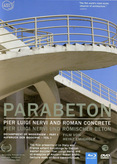
'Parabeton' beginnt mit dem ersten, noch existierenden Kuppelbau aus römischem Beton in Baiae bei Neapel, erbaut im 1. Jahrhundert vor Christi. Dann folgen in chronologischer Abfolge siebzehn in Italien und Frankreich noch erhaltene Bauwerke des italienischen Bauingenieurs Pier Luigi Nervi (1891-1979), darunter das Pirelli-Hochhaus in Mailand, der Hauptsitz der UNESCO in Paris, das Haus der Arbeit in Turin, der Große Sportpalast in Rom und die Audienzhalle des Papstes im Vatikan. Nervi ist als Erfinder stilbildender Konstruktionen der Großmeister des Betonbaus und der Architect's Architect des 20. Jahrhunderts. Unterbrochen wird die Abfolge der Nervi-Bauten durch filmische Studien antiker Bauten aus römischem Beton aus den ersten Jahrhunderten nach Christi, darunter das Pantheon und die Caracalla Thermen in Rom. Der Film setzt damit Nervis kühne Konstruktionen zu den bahnbrechenden römischen Erfindungen von vor zweitausen Jahren in Beziehung. Mit dem Rückbezug des Konstruktionskerns der Moderne auf die Betonbauten der Antike bildet der Film 'Parabeton' das Finale der Serie von Architekturfilmen an der Heinz Emigholz seit 1992 arbeitet.
Die Dreharbeiten zum Film 'Parabeton' fanden von März bis Mai 2011 in Italien und Frankreich statt. Der Film zeigt folgende Bauwerke:
Tempel des Merkur (1. Jahrhundert v. Ch.) in Baiae bei Neapel
Stadion Artemio Franchi (1932) in Florenz
Experimentelles Lagerhaus (1945) in Rom
Tempel des Jupiter Anxur (1. Jahrhundert v. Ch.) in Terracina
Ausstellungshalle B (1948) in Turin
Ausstellungshalle C (1950) in Turin
Salzlagerhallen (1951) in Tortona
Tabakfabrik (1953) in Bologna
Caracalla Thermen (3. Jahrhundert n. Ch.) in Rom
Hauptsitz der UNESCO (1958, mit Marcel Breuer und Bernhard Zehrfuss) in Paris
Pantheon (2. Jahrhundert n. Ch.) in Rom
Kleiner Sportkomplex (1957, mit Annibale Vittellozzi) in Rom
Tempel der Minerva (3. Jahrhundert n. Ch.) in Rom
Pirelli Hochhaus (1958, mit Arturo Danusso) in Mailand
Stadion Flaminio (1959, mit Antonio Nervi) in Rom
Colosseum und Forum Romanum (1. Jahrhundert v. Ch.) in Rom
Sportkomplex (1960, mit Marcello Piacentini) in Rom
Claudia Aquädukt (1. Jahrhundert n. Ch.) in Rom
Bahnhof (1960, mit Antonio Nervi) in Savona
Palast der Arbeit (1961, mit Antonio Nervi) in Turin
Hadrians Villa (2. Jahrhundert n. Ch.) in Tivoli bei Rom
Burgo Papierfabrik (1962, mit Antonio Nervi) in Mantua
Mausoleum Tor de 'Schiavi (4. Jahrhundert n. Ch.) in Rom
Dach der Kirche Cuore Immacolato di Maria (1962, mit Giuseppe Vaccaro) in Bologna
Palatin und FAO Fischerboot aus Eisenbeton (1967) in Rom
Audienzhalle des Pabstes (1971, mit Antonio Nervi) in Rom, Vatikanstadt
Weiterlesen »
'Parabeton' begins with the first surviving domed building made of Roman concrete in Baiae near Naples, built in the 1st century BC. This is followed in chronological order by seventeen buildings by the Italian civil engineer Pier Luigi Nervi (1891-1979) that are still preserved in Italy and France, including the Pirelli skyscraper in Milan, the headquarters of UNESCO in Paris, the House of Labour in Turin, the Grand Sports Palace in Rome and the Pope's audience hall in the Vatican. As the inventor of style-defining constructions, Nervi is the grandmaster of concrete construction and the Architect's Architect of the 20th century. The sequence of Nervi buildings is interrupted by cinematic studies of ancient buildings made of Roman concrete from the first centuries AD, including the Pantheon and the Baths of Caracalla in Rome. The film thus relates Nervi's bold constructions to the groundbreaking Roman inventions of two thousand years ago. With the reference of the construction core of modernism to the concrete buildings of antiquity, the film 'Parabeton' forms the finale of the series of architectural films on which Heinz Emigholz has been working since 1992.
The filming of the film 'Parabeton' took place from March to May 2011 in Italy and France. The film shows the following buildings:
Temple of Mercury (1st century BC) in Baiae near Naples
Artemio Franchi Stadium (1932) in Florence
Experimental warehouse (1945) in Rome
Temple of Jupiter Anxur (1st century BC) in Terracina
Exhibition Hall B (1948) in Turin
Exhibition Hall C (1950) in Turin
Salt warehouses (1951) in Tortona
Tobacco factory (1953) in Bologna
Baths of Caracalla (3rd century AD) in Rome
UNESCO headquarters (1958, with Marcel Breuer and Bernhard Zehrfuss) in Paris
Pantheon (2nd century AD) in Rome
Small sports complex (1957, with Annibale Vittellozzi) in Rome
Temple of Minerva (3rd century AD) in Rome
Pirelli skyscraper (1958, with Arturo Danusso) in Milan
Flaminio Stadium (1959, with Antonio Nervi) in Rome
Colosseum and Roman Forum (1st century BC) in Rome
Sports complex (1960, with Marcello Piacentini) in Rome
Claudia Aqueduct (1st century AD) in Rome
Railway station (1960, with Antonio Nervi) in Savona
Palace of Labour (1961, with Antonio Nervi) in Turin
Hadrian's villa (2nd century AD) in Tivoli near Rome
Burgo paper mill (1962, with Antonio Nervi) in Mantua
Mausoleum Tor de 'Schiavi (4th century AD) in Rome
Roof of the church Cuore Immacolato di Maria (1962, with Giuseppe Vaccaro) in Bologna
Palatine Hill and FAO Reinforced Concrete Fishing Boat (1967) in Rome
Audience Hall of the Pope (1971, with Antonio Nervi) in Rome, Vatican City
More »